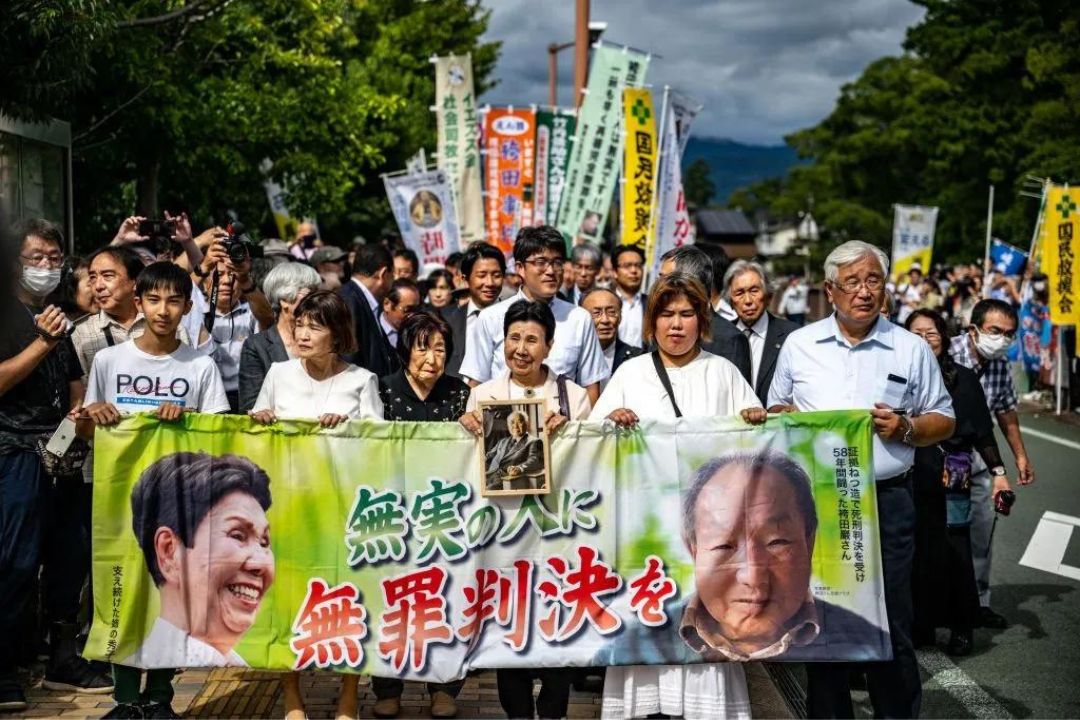
A Japanese court has concluded that the evidence used against an 88-year-old man who has been on death row for the longest period of time was falsified, leading to his acquittal.
Iwao Hakamada was convicted in 1968 of killing his boss, the man’s wife, and their two teenage children. He has been on execution row for more than 50 years.
A retrial was recently granted for him due to suspicions that the evidence used to convict him of triple murder may have been fabricated by the investigators.
“Japan acquits the death row inmate with the world’s longest sentence in history”
Hakamada’s mental state had suffered greatly over his more than fifty years on death row, therefore he was deemed unsuitable to attend the hearing when his acquittal was ultimately granted.
Approximately 500 people lined up for seats in the Shizuoka courtroom on Thursday, demonstrating the level of public interest in one of the longest running and most well-known judicial sagas in Japan: the Hakamada case.
Outside the court, Hakamada’s supporters’ cheered “banzai,” a Japanese expression meaning “hurray,” as the verdict was delivered.
Hakamada was released from prison in 2014 and given permission for a retrial. Because of his worsening mental health, he was exempted from all hearings and has been living with his 91-year-old sister Hideko.
His fight for justice, he had previously told the AFP news agency, was like “fighting a bout every day.”
He said, “There is no path to victory once you think you can’t victory!”
Clothes that are “bloodstained” in a miso tank
Hakamada, a former professional boxer, was employed at a miso processing company in 1966 when his employer’s wife and two children, as well as his own body, were discovered after a fire at their Shizuoka, a city west of Tokyo, residence. They’d all four been fatally stabbed.
Hakamada was charged by the authorities with killing the family, stealing 200,000 yen in cash, and setting their house on fire.
After being beaten and questioned for up to 12 hours a day, Hakamada eventually made what he later described as a forced confession. At first, he denied having robbed and killed the victims.
He was found guilty of murder and arson in 1968 and given the death penalty.
A year after Hakamada’s arrest, the decades-long judicial drama finally turned on some clothing discovered in a miso tank. Those allegedly bloodstained garments served as evidence against him.
But Hakamada’s attorneys contended for years that the clothing’s DNA did not match his, suggesting that the objects might have belonged to someone else. The attorneys went on to say that the cops might have made up the evidence.
Judge Hiroaki Murayama was convinced by their case and remarked in 2014 that “the clothes were not those of the defendant.”
At the time, Murayama stated, “It is unjust to detain the defendant further, as the possibility of his innocence has become clear to a respectable degree.”
After that, a retrial was granted and Hakamada was freed from prison.
That retrial didn’t start until last year due to drawn-out legal proceedings, and the court didn’t announce the verdict until Thursday morning.
The judge rejected the defense attorneys’ second reasonable argument, which was that the red stains on the clothing could not have been blood since blood would not stay red on clothing that had been submerged in miso for a year. However, the judge rejected the DNA claim.
According to AFP, the decision on Thursday stated that “investigators tampered with clothes by getting blood on them,” which they then concealed in the miso tank.
Hakamada was found not guilty.
At the time, Murayama stated, “It is unjust to detain the defendant further, as the possibility of his innocence has become clear to a respectable degree.”
After that, a retrial was granted and Hakamada was freed from prison.
That retrial didn’t start until last year due to drawn-out legal proceedings, and the court didn’t announce the verdict until Thursday morning.
The judge rejected the defence attorneys’ second reasonable argument, which was that the red stains on the clothing could not have been blood since blood would not stay red on clothing that had been submerged in miso for a year. However, the judge rejected the DNA claim.
According to AFP, the decision on Thursday stated that “investigators tampered with clothes by getting blood on them,” which they then concealed in the miso tank.