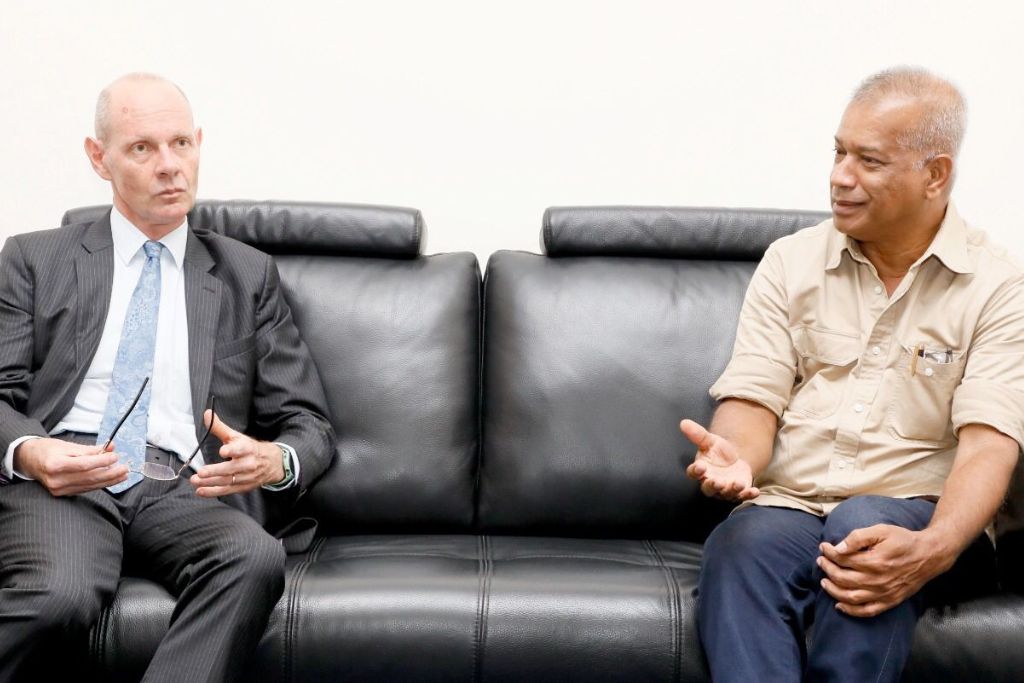
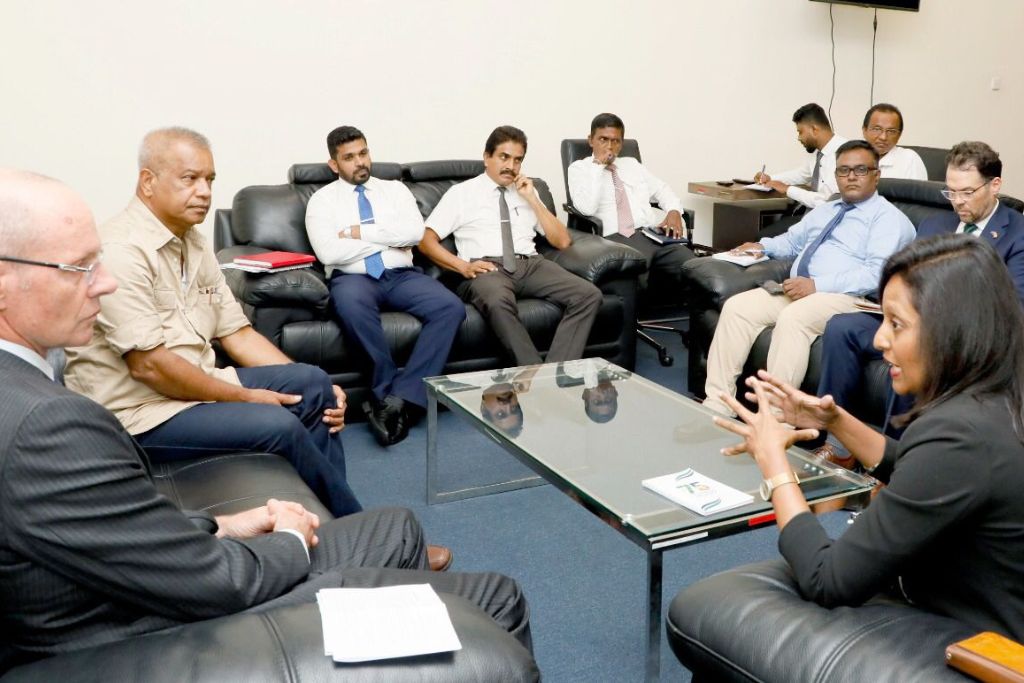
A special discussion was held on the 15th at the Ministry of Agriculture with the aim of strengthening the existing relations between Sri Lanka and Australia and further advancing agricultural ties between the two countries. The meeting was between the Minister of Agriculture, Livestock, Lands, and Irrigation, K.D. Lalkantha, and the Australian High Commissioner, Paul Stephens. Representatives from the Australian High Commission present at this occasion included Deputy High Commissioner Lalita Kapoor, Paul Stephens, and Sivasuthan Ramanathan. Representing the Ministry of Agriculture were Ajith Pushpakumara, H.M. Amarasinghe, Hemajeeva Gotabhaya, and other officials.
“Meeting between the Australian Ambassador and the Minister of Agriculture”
The Australian High Commissioner first congratulated the National People’s Power (Jathika Jana Balavegaya) on their significant victory and stated their readiness to work closely and with trust with the new government. He also inquired about the Minister’s views on new agricultural and cultivation plans in Sri Lanka. The High Commissioner noted that Australia has long assisted in uplifting agriculture in Sri Lanka and expressed their expectation to continue providing necessary financial and advisory services to develop local agriculture in the future. Furthermore, the High Commissioner mentioned that special attention would be given to improving coffee cultivation in Sri Lanka.
In response, the Minister stated that to uplift agriculture in Sri Lanka, measures should be taken to minimize the fragmentation of land, and that necessary steps are already being implemented in this regard. He also stated that existing farmlands should be developed into large cultivation areas while securing the land ownership of the farmers, and that farmer companies formed by farmers joining together should be established for this purpose.
Furthermore, the Minister stated that by extending this company system beyond agriculture to several sectors including dairy farming and the poultry and egg industries, production costs could be minimized and the income of the farming population could be increased.