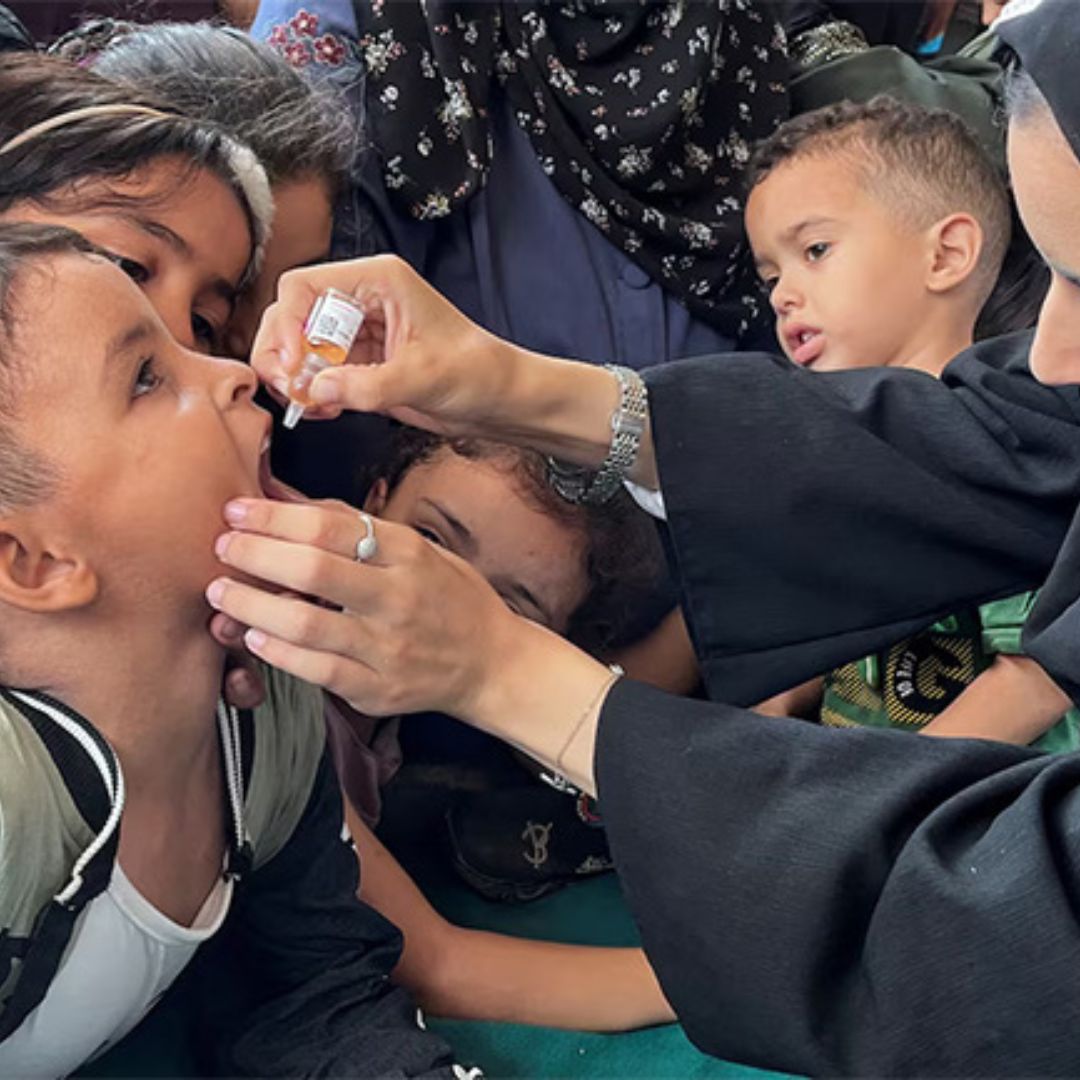
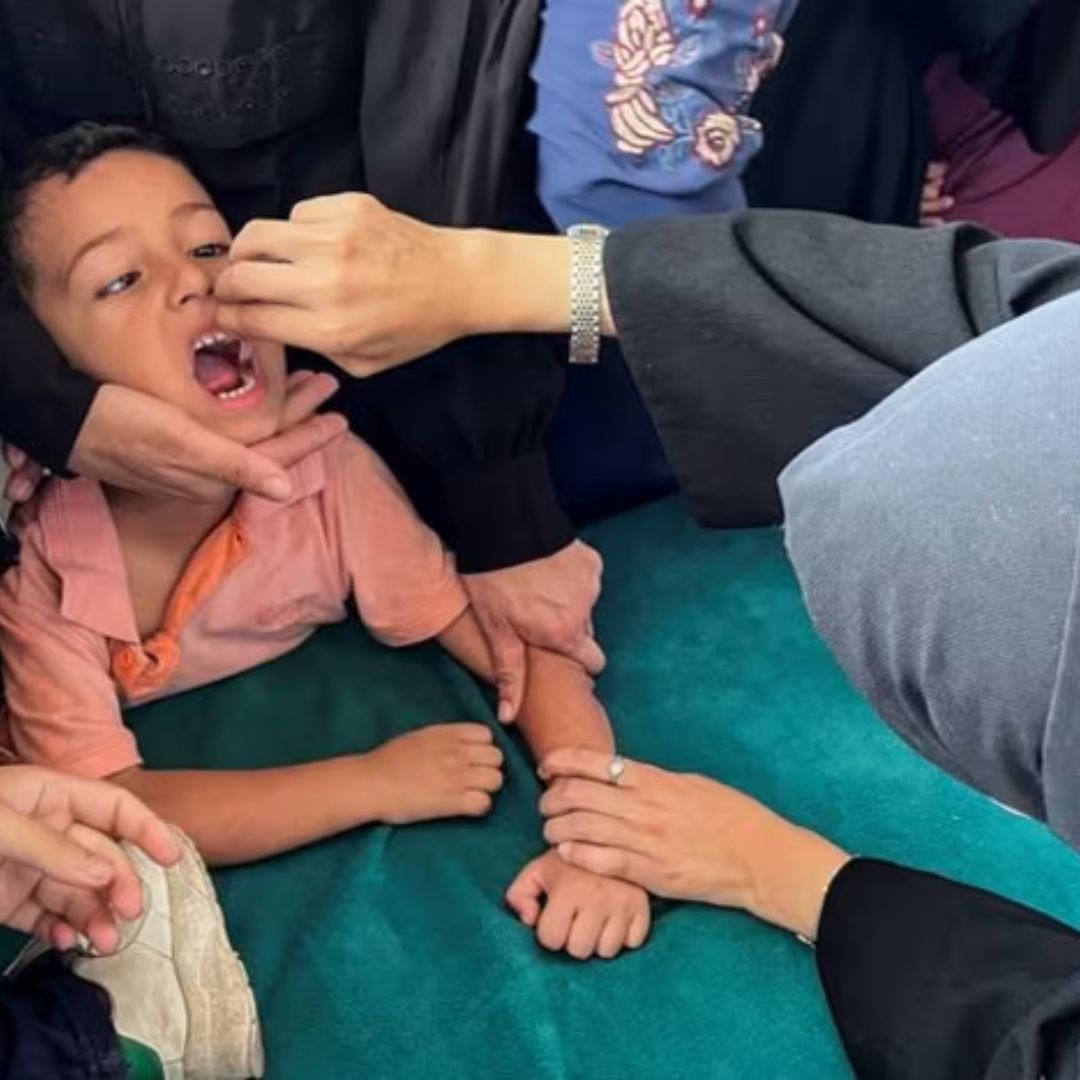
After Israel and Hamas agreed to short pauses in their 11-month war, the United Nations, working with Palestinian health authorities, started vaccinating 640,000 children in the Gaza Strip on Sunday.The type 2 polio virus partially paralysed a baby last month, according to confirmation from the World Health Organisation (WHO). This is the first case of its kind in the region in 25 years.
The campaign started on Sunday in some parts of central Gaza and will soon spread to other areas. There will be a minimum of eight-hour break in fighting for three days in a row.
“As fighting rages, the UN starts polio vaccination campaigns in Gaza.”
According to the WHO, the first round of vaccinations will take slightly less than two weeks, and the pauses will probably need to be extended to a fourth day.Palestinian officials said that children, escorted by family members, crammed a UN-run clinic in the central Gaza city of Deir Al-Balah, where about a million people were seeking refuge. Children who received the drops were marked by medical staff members with pens on their fingers.
“Today, I visited the UNRWA clinic to vaccinate my daughters against polio. Hopefully, we will only encounter the diseases we currently have.” “My hope is that we will return safely to our homes,” expressed Gaza mother Afnan Al-Muqayyad.
Among Al-Muqayyad’s many worries was polio.
Skin diseases are common, detergents are scarce, and we cannot afford the exorbitant cost of detergents. In addition, everything is pricey, including the food, and the kids’ weight is decreasing; they were healthy before but are now extremely skinny. “I pray that God will make everything right,” she uttered.
“COMPLEX” CAMPAIGN The vaccination campaign is large-scale and “one of the most complex in the world,” according to Juliette Touma, director of communications for UNRWA, the United Nations agency for Palestinian refugees.
“Today is a test for the parties involved in the conflict to honour these area pauses so that UNRWA teams and other medical personnel can provide these two extremely valuable drops to children. “Time is of the essence,” Touma stated to Reuters.In order to make the campaign successful, Israel and Hamas, who have so far been unable to come to an agreement that would end the war, declared that they would work together.
According to WHO officials, for the campaign to be successful, at least 90% of the children must receive two vaccinations, separated by four weeks, but Gaza, which has been severely damaged by the conflict, presents significant obstacles.
Children are still at risk; it transcends national boundaries, frontiers, and front lines of conflict. To reduce the likelihood of this terrible illness spreading, all children in Gaza and Israel need to receive vaccinations, according to Touma.Israeli forces were still engaged in combat with militants led by Hamas in a number of the Palestinian enclave’s locations. While tanks were still in operation in the Zeitoun suburb of northern Gaza City, residents reported that Israeli army troops had detonated multiple houses in Rafah, close to the Egyptian border.
Six hostages were killed, it seems, not long before Israeli troops arrived at their tunnel in southern Gaza, from which Israel recovered their bodies on Sunday, according to the military.
After Hamas militants invaded southern Israel on October 7, killing 1,200 people and kidnapping over 250 more, according to Israeli estimates, the conflict was started.The health ministry of the enclave reports that since then, there have been at least 40,691 Palestinian deaths and 94,060 injuries in Gaza.