

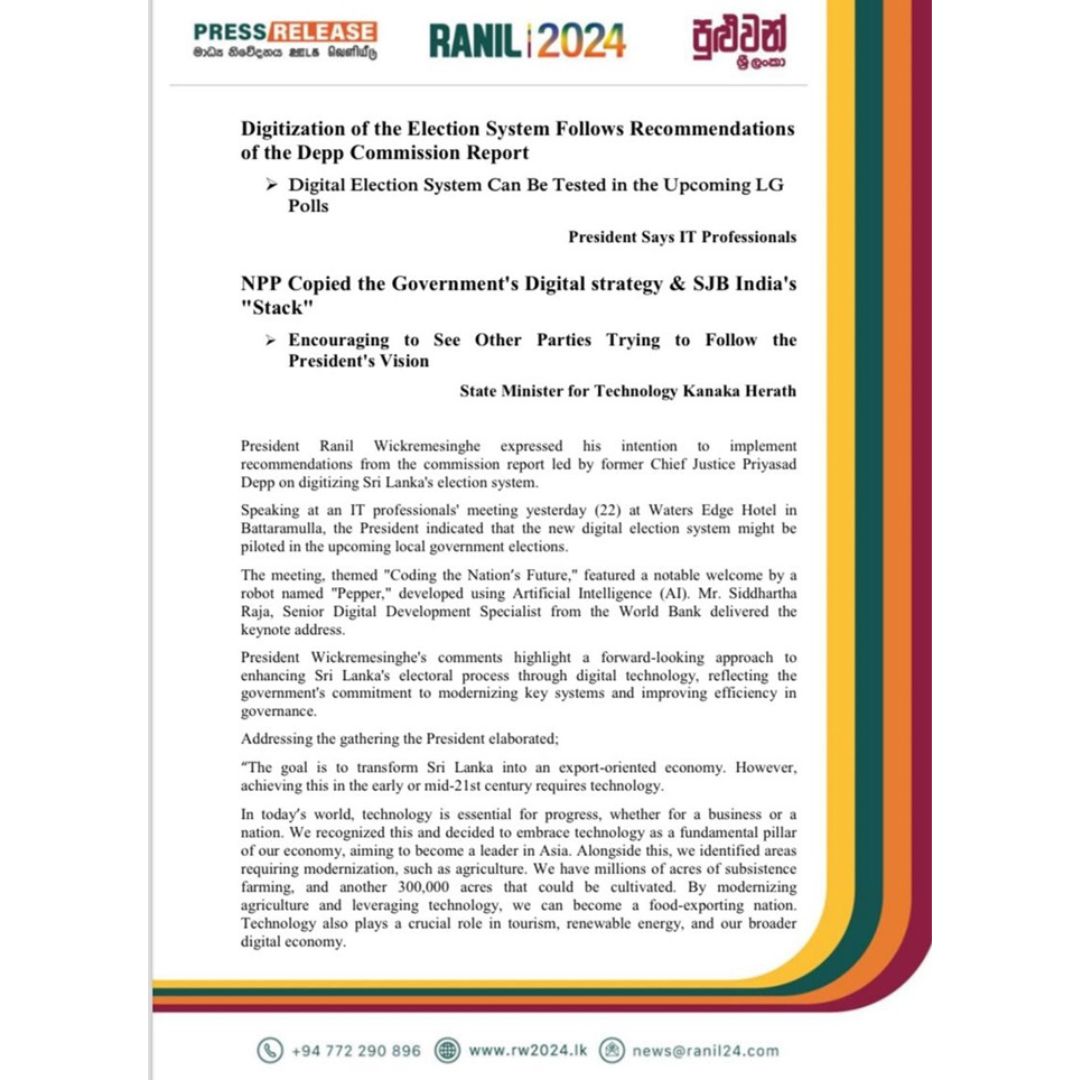
-President Says IT Professionals
President Ranil Wickremesinghe expressed his intention to implement recommendations from the commission report led by former Chief Justice Priyasad Depp on digitizing Sri Lanka’s election system.
Speaking at an IT professionals’ meeting Thursday (22) at Waters Edge Hotel in Battaramulla, the President indicated that the new digital election system might be piloted in the upcoming local government elections.
“Digitization of the Election System Follows Recommendations of the Depp Commission Report”
The meeting, themed “Coding the Nation’s Future,” featured a notable welcome by a robot named “Pepper,” developed using Artificial Intelligence (AI). Mr. Siddhartha Raja, Senior Digital Development Specialist from the World Bank delivered the keynote address.President Wickremesinghe’s comments highlight a forward-looking approach to
enhancing Sri Lanka’s electoral process through digital technology, reflecting the government’s commitment to modernizing key systems and improving efficiency in governance.Addressing the gathering the President elaborated;
“The goal is to transform Sri Lanka into an export-oriented economy. However,achieving this in the early or mid-21st century requires technology.In today’s world, technology is essential for progress, whether for a business or a nation. We recognized this and decided to embrace technology as a fundamental pillar
of our economy, aiming to become a leader in Asia. Alongside this, we identified areas requiring modernization, such as agriculture. We have millions of acres of subsistence farming, and another 300,000 acres that could be cultivated. By modernizing agriculture and leveraging technology, we can become a food-exporting nation.Technology also plays a crucial role in tourism, renewable energy, and our broader digital economy.
Our economy now has two key characteristics: digitalization and a green economy.Both go hand in hand. The question we must answer is how to initiate this transformation and where to go from here. Previous government policies on science and technology focused heavily on state-driven initiatives with limited results. We are moving away from this approach to one that is market-driven and led by the private
sector. The government will support research in pure sciences through the National Science Foundation and manage research funding more effectively. For commercially driven research, the newly established council will fund and support projects with a market focus, ensuring success through collaboration.
Additionally, the Digital Transformation Agency and the Centre for AI will play key roles in driving technological advancement. However, the government’s primary responsibility is to provide infrastructure, enact laws, and cultivate human resources.
We must focus on producing skilled talent, knowing that some will go abroad, but as salaries improve, more will stay.We also need to modernize schools to prepare them for the 2030s and 2040s, a process
that will take time. Vocational education is being radically reorganized, with vocational training centers and institutes being consolidated under the Vocational Skills Agency of Sri Lanka. We will also establish University Colleges of Technology and Management to offer associate degrees, expand existing state universities, and promote non-government universities in technology.The government is committed to establishing four new universities, including a campus of the Chennai IIT in Galaha, a gift from Prime Minister Modi, as well as new technology universities in Kurunegala, Seethawaka, and Siyane. We hope to see more private universities in Sri Lanka as well.
With this infrastructure and talent in place, we can fund innovation and expand the sector. Rather than reinventing the wheel, we plan to build on India’s successes,accelerating our progress by adopting proven methods.Our goal is to develop a USD 15 billion digital economy as part of our broader vision
for an USD 85 billion economy. By mid-century, we aim to become USD 350 billion economy or more. We are positioned near South India, home to some of the most technologically advanced states. Let’s leverage this proximity and advance together.We must live in the present and focus on technology. In various fields, we aspire to be leaders or at least frontrunners. To move the economy forward, we must move together,and we are ready to work alongside you.”
State Minister for Technology Kanaka Herath:
“We need the continued support of the industry. This government has always worked hand in hand with you and I trust that you will stand by us to ensure that the development of the industry continues.
I must also address an encouraging point. Our digital strategy has already been copied by NPP and the SJB’s digital policy is a direct reproduction of India’s “Stack”. The encouraging point is that the other parties are trying to follow the footsteps of the President’s vision. This is a good sign for the country and I hope they will read the full Act and support it when we present it to Parliament shortly.”President of the Sri Lanka Association of Software and Service Companies (SLASSCOM) Mr. Nishan Mendis, Executive Member of the BCS Institute of
Information Technology Mr. Imran Vilcassim, President of the Sri Lanka Information Technology Industry Federation (FITIS) Mr. Indika De Soyza and Vice President of the Sri Lanka Computer Association Mr. Heshan Samaratunga, along with President Ranil Wickremesinghe, participated in a panel discussion. During the deliberations, the President provided proactive responses to the questions posed by the professionals in the IT industry
Media Unit
Ranil 2024 – Puluwan Sri Lanka